A collaboration of the University of Stuttgart, University of Tübingen, Max Planck Institute for Intelligent Systems, and Max Planck Institute for Biological Cybernetics, part of Cyber Valley.
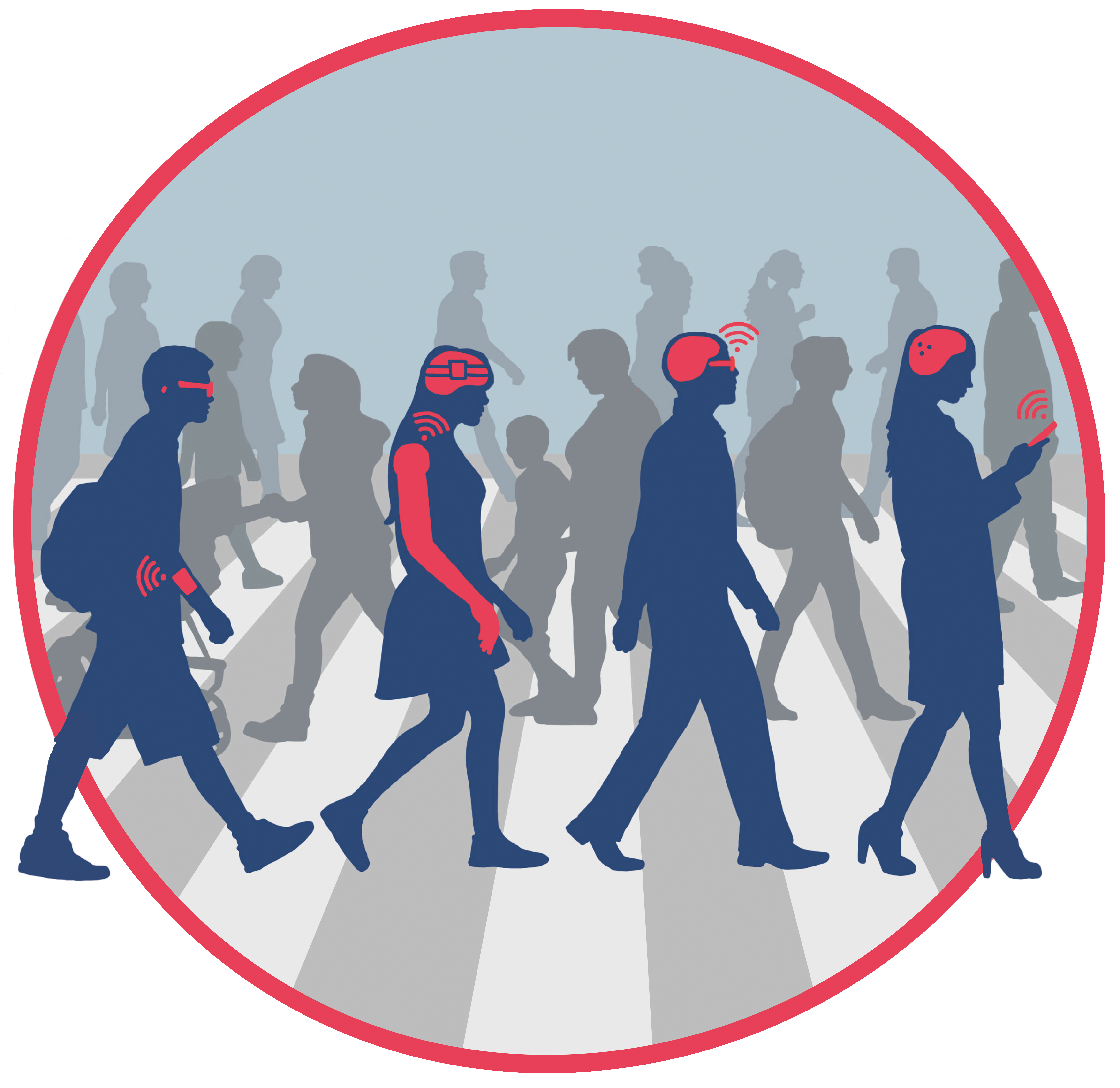
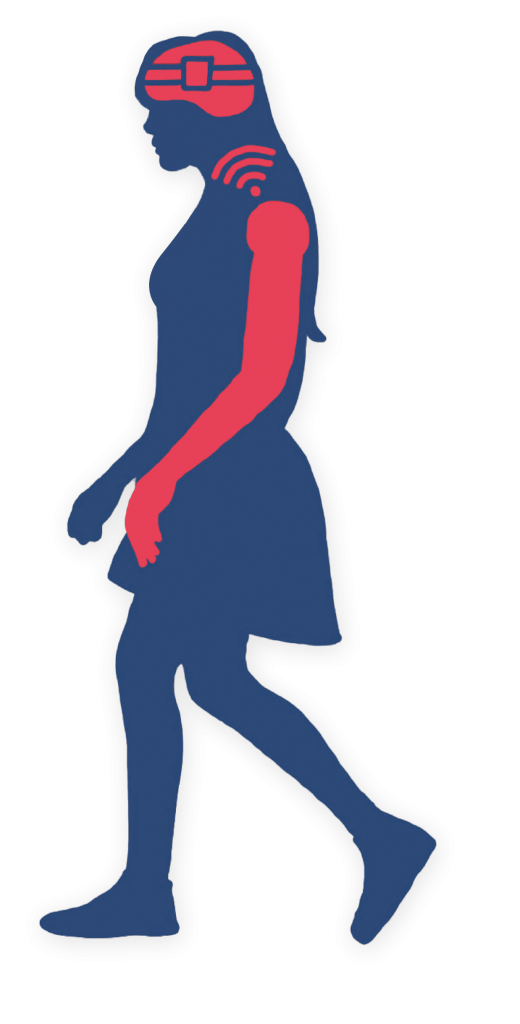
The Center for Bionic Intelligence Tübingen Stuttgart (BITS) will support to establish a radically new approach for the tight integration of intelligent technological systems with humans. At its culmination, we will be able to overcome technical limitations of current treatment and support systems for neural diseases, compensating for deficiencies and restoring intelligent bodily functions. This will markedly reduce the ever-increasing societal burden of psychiatric and neurological diseases.
Human embodied intelligence results from the smart interplay between neural information processing and physical properties of the body, both tightly integrated in a closed-loop fashion. Such an interplay must be extended to systems that integrate humans with technology.
The BITS Center uniquely combines the complementary excellence of the Universities of Stuttgart and Tübingen and the associated Max Planck Institutes for Intelligent Systems and Biological Cybernetics as ideal setting and fits perfectly in the regional academic-industrial ecosystem.
current news
BITS at Cyber Valley Day - Ten years of Cyber Valley: A dynamic ecosystem for AI and robotics
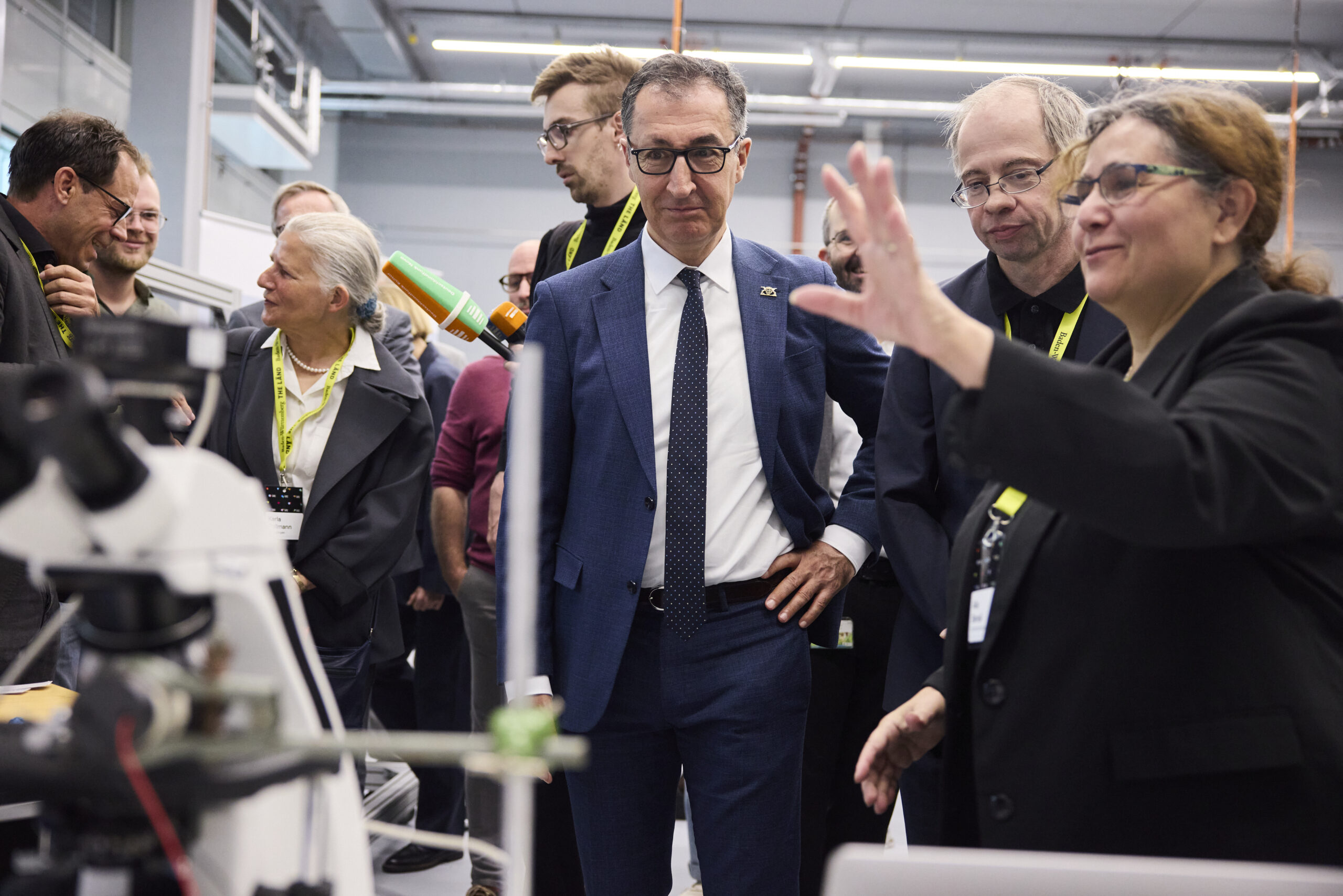
This year’s Cyber Valley Day was all about the anniversary. As a co-founder of the internationally renowned Baden-Württemberg Innovation Campus, the University of Stuttgart showcased excellent research and innovative technologies for a wide range of applications in science and practice
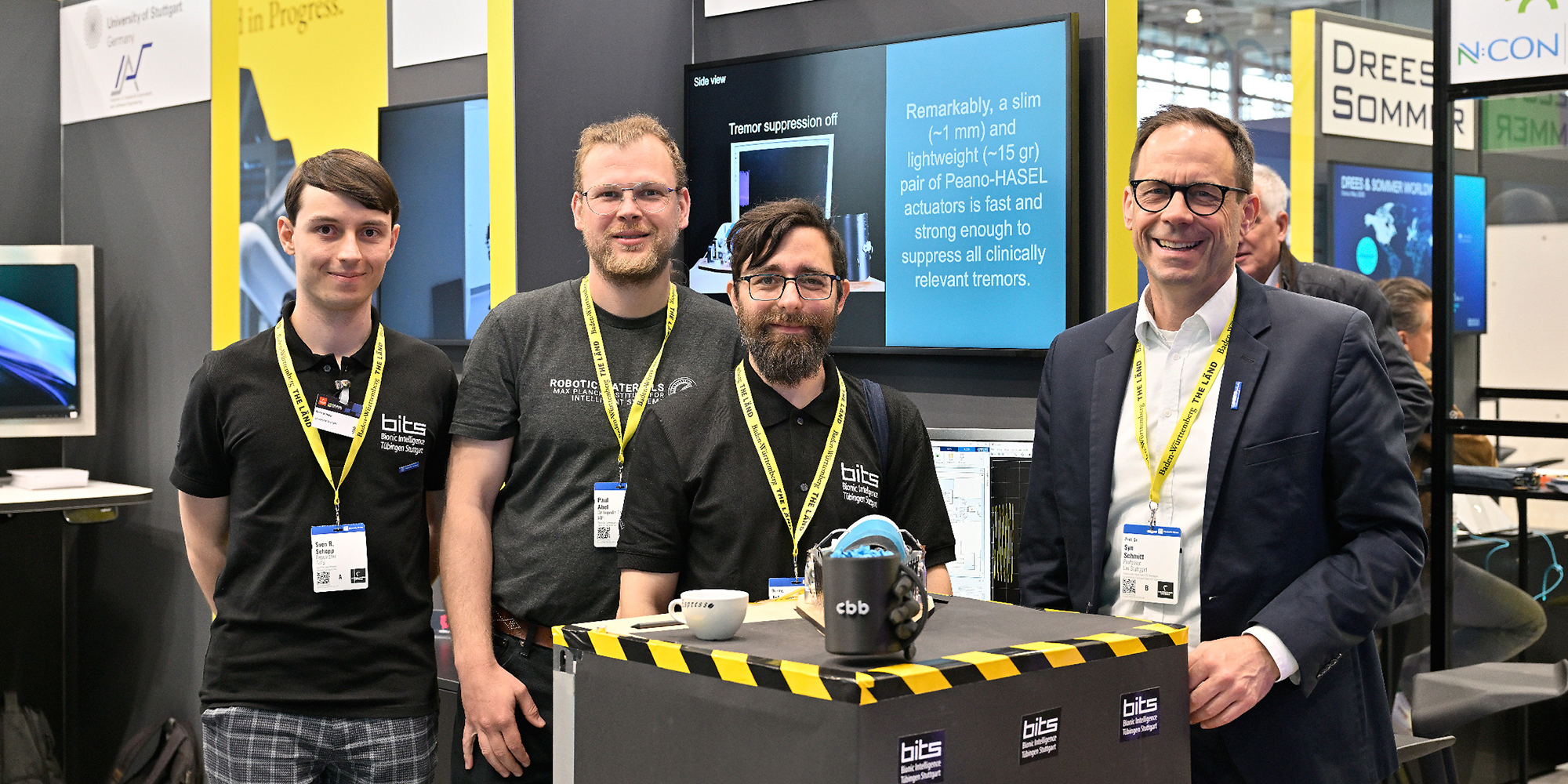
Cutting-edge research at the Hannover Messe. Biorobotics for Tremor Suppression represented by BITS
The University of Stuttgart is showcasing biorobotics, green hydrogen production, digital solutions for businesses, and student space projects.
The exhibit: A biorobotic arm that suppresses tremors. The Center for Bionic Intelligence Tübingen Stuttgart (BITS) is introducing an assistive system for Parkinson’s patients designed to suppress tremors. Scientists from the Institute for Modeling and Simulation of Biomechanical Systems (IMSB) at the University of Stuttgart and the Max Planck Institute for Intelligent Systems (MPI-IS) explain how the arm simulates and compensates for tremors and why this function resembles that of noise-canceling headphones
Continuum biomechanics, mechanobiology, quantum sensing of motion, diffusion tensor imaging
University of Stuttgart Institute of Modelling and Simulation of Biomechanical Systems (IMSB) Pfaffenaldring 5a 70569 Stuttgart +49 711 685 66284 roehrle@simtech.uni-stuttgart.de
University of Tübingen Centre for Integrative Neuroscience (CIN) Hertie Institute for Clinical Brain Research (HIH) Level 2, room 517 Otfried-Müller-Str. 25 72076 Tübingen +49 7071 29 88830 isabell.wochner@uni-tuebingen.de
Control and systems theory, robust and adaptive optimization-based control, system identification, learning-based control
Universiy of Stuttgart Institute for Systems Theory and Automatic Control Pfaffenwaldring 9 70569 Stuttgart +49 711 685 67730 andrea.iannelli@ist.uni-stuttgart.de
Medical Microrobotics, Biomedical Microfluidics, Acoustics, Biomedical Ultrasound, Smart Materials
University of Stuttgart Institute of Biomaterials and Biomolecular Systems (IBBS) Microrobotic Biomedical Systems Pfaffenwaldring 57 70569 Stuttgart +49 711 685 65011 amirreza.aghakhani@bio.uni-stuttgart.de
Neuro-oncology, cellular and molecular neuroscience, cellular interactions, preclinical glioma models, early phase clinical trials
University Hospital Tübingen Hertie Institute for Clinical Brain Research Department of Neurology and Interdisciplinary Neuro-Oncology Hoppe-Seyler-Strasse 3 72076 Tübingen +49 7071 29 83269 ghazaleh.tabatabai@uni-tuebingen.de
Work physiology, ergonomics, occupational physical exposures, exoskeleton
University Hospital Tübingen Institute of Occupational and Social Medicine and Health Services Research Wilhelmstr. 27 72074 Tübingen +49 7071 29 86805 benjamin.steinhilber@med.uni-tuebingen.de
Statistical physics, active matter, and small-scale robotics
University of Stuttgart Institute for Theoretical Physics IV Fraunhofer-Institute for Manufacturing Engineering and Automation (IPA) Heisenbergstr. 3 70569 Stuttgart +49 711 685 65248 thomas.speck@itp4.uni-stuttgart.de
Neuromodulation, neurosurgery, deep brain stimulation, neuroprosthetics, neurorobotics, neurorehabilitation
University of Tübingen Institute for Neuromodulation and Neurotechnology Otfried-Müller-Str.45 72076 Tübingen + 49 7071 29 85197 alireza.gharabaghi@uni-tuebingen.de
My research interest are focused on (multi-)functional soft materials, on (in-situ) characterization of their functional (e.g. thermal, optical and electronic) properties and their mechanical behavior, and multiscale-modelling which allows to predict material behavior based on advanced (data-integrated) numerical simulations.
University of Stuttgart Institute of Applied Mechanics Pfaffenwaldring 7, Room 3/104 70569 Stuttgart +49 711 685 66346 holger.steeb@mechbau.uni-stuttgart.de
University of Stuttgart Institute for Visualization and Interactive Systems Allmandring 19 70569 Stuttgart +49 711 685 88601 dieter.schmalstieg@visus.uni-stuttgart.de
Theoretical neuroscience, movement and social perception, modeling / analysis of body movement and biomedical appplications
University of Tübingen Hertie Institute for Clinical Brain Research (HIH) Centre for Integrative Neuroscience (CIN) Section for Computational Sensomotorics Dept. for Cognitive Neurology Otfried-Müller-Str. 25 72076 Tübingen +49 7071 29 89 124 martin.giese@uni-tuebingen.de
Digitally enhanced psychotherapy in children and adolescents, multimodal sensors in real-life diagnostics and therapy, neurobiology of psychiatric disorders in children and adolescents
University Hospital Tübingen Psychiatry, psychosomatics and psychotherapy in childhood and adolescence German Center for Mental Health (DZPG) Osianderstr. 14 72076 Tübingen +49 7071 29 82292 tobias.renner@med.uni-tuebingen.de
Bionic actuators, biocompatible, biogene and biodegradable materials, prosthetics & orthotics, biointelligent production
Fraunhofer-Institute for Manufacturing Engineering and Automation (IPA) Dept. of Biomechatronic Systems and Centre for Biointelligent Production Nobelstr. 12 70569 Stuttgart +49 711 970 3754 Oliver.Schwarz@ipa.fraunhofer.de
Biomechatronics, medical device research, prosthetics & orthotics, human machine interaction, exoskeletons
Fraunhofer-Institute for Manufacturing Engineering and Automation (IPA) Head of Department Nobelstr. 12 70569 Stuttgart +49 711 970 3630 Urs.Schneider@ipa.fraunhofer.de
Personalized production, complexity in production, IoT for industries, production strategies, biological transformation of value creation
University of Stuttgart Director of Institute of Industrial Manufacturing and Management (IFF) and Fraunhofer-Institute for Manufacturing Engineering and Automation (IPA) Nobelstr. 12 70569 Stuttgart +49 711 970 1101 thomas.bauernhansl@iff.uni-stuttgart.de
Nonlinear control, networked control, predictive control, data-based control, process control, mechatronics, biomedical technology, nanotechnology, systems biology
University of Stuttgart Institute for Systems Theory and Automatic Control Director Pfaffenwaldring 9 70569 Stuttgart +49 711 685 67733 frank.allgower@ist.uni-stuttgart.de
Visual neuroscience, retinal signal processing in health and disease, multiphoton imaging
University of Tübingen Centre for Integrative Neuroscience (CIN) Otfried-Müller-Str. 25 72076 Tübingen +49 7071 29 85028 thomas.euler@cin.uni-tuebingen.de
Systems neuroscience, brain stimulation, sensorimotor and motor system, multisite neuronal interrogation
University of Tübingen Systems Neurophysiology Centre for Integrative Neuroscience (CIN) Otfried-Müller-Str. 25 72076 Tübingen +49 7071 29 80462 cornelius.schwarz@uni-tuebingen.de
Neural dynamics and interactions, cognition and behavior, neurophysiology, MEG/EEG, MMG/EMG
We investigate how cognition and behavior emerge from dynamic interactions across neuronal ensembles and how these interactions are disturbed in the diseased brain. We employ an interdisciplinary multi-scale approach that links large-scale population measures of neuronal activity to circuit and cellular-level mechanisms. We combine human magneto- and electroencephalography (MEG, EEG), magneto- and electromyography (MMG, EMG), animal electrophysiology, psychophysics and sophisticated analytical techniques.
University of Tübingen Hertie-Institute for Clinical Brain Research (HIH) Otfried-Müller-Str. 25 72076 Tübingen +49 7071 29 85297 markus.siegel@uni-tuebingen.de
University of Stuttgart Interchange Forum for Reflecting on Intelligent Systems c/o Teaching and Learning with Intelligent Systems Geschwister-Scholl-Str. 24D 70174 Stuttgart maria.wirzberger@iris.uni-stuttgart.de
Nonlinear control, networked control, predictive control, data-based control, process control, mechatronics, biomedical technology, nanotechnology, systems biology
University of Stuttgart Institute for Systems Theory and Automatic Control Director Pfaffenwaldring 9 70569 Stuttgart +49 711 685 67733 frank.allgower@ist.uni-stuttgart.de
Bionic actuators, biocompatible, biogene and biodegradable materials, prosthetics & orthotics, biointelligent production
Fraunhofer-Institute for Manufacturing Engineering and Automation (IPA) Dept. of Biomechatronic Systems and Centre for Biointelligent Production Nobelstr. 12 70569 Stuttgart +49 711 970 3754 Oliver.Schwarz@ipa.fraunhofer.de
Parkinson’s disease, gait, deep brain stimulation, neuronal time series, basal ganglia – cortical – spinal circuits
University of Tübingen Center of Neurology Hertie Institute for Clinical Brain Research (HIH) Hoppe-Seyler-Str. 3 72076 Tübingen +49 7071 29 82340 daniel.weiss@uni-tuebingen.de
Digital and molecular stratification, progression and treatment response markers for neurodegenerative diseases, upper and lower limb digital motor outcomes for neurological disease, innovative neurorehabilitative treatment strategies for neurodegenerative diseases, individualized systems and RNA therapy for rare neurological diseases
University of Tübingen Head, Division Translational Genomics of Neurodegenerative Diseases Center of Neurology Hertie Institute for Clinical Brain Research (HIH) Hoppe-Seyler-Str. 3 72076 Tübingen +49 7071 29 82060 matthis.synofzik@uni-tuebingen.de
Physical intelligence, small-scale robotics, wireless medical milli/microrobots, bioinspired materials and robots, wireless neural stimulation
Former Director, Max Planck Institute for Intelligent Systems Honorary Professor, University of Stuttgart Koç University, President Professor, School of Medicine and College of Engineering President’s Office Rumelifeneri Mah. 34450 Istanbul, Turkey +90-212-3381215
In my research, I mainly focus on the experimental investigation and modelling of muscles. Furthermore, I examine acute and chronic adaptations of the neuromuscular system to age, training and movement as well as interactions of the neuromuscular system with external devices.
University of Stuttgart Motion and Exercise Science Stuttgart Center for Simulation Science (SC SimTech) Allmandring 28 70569 Stuttgart +49 711 685 60455 | +49 711 685 63165 tobias.siebert@inspo.uni-stuttgart.de
University of Stuttgart Institute for Visualization and Interactive Systems (VISUS) Allmandring 19, Room 01.010 70569 Stuttgart +49 711 685 88603 michael.sedlmair@visus.uni-stuttgart.de
High-field and ultra-low field magnetic resonance technology, RF technology, brain physiology
Max Planck Institute for Biological Cybernetics Department for High-field Magnetic Resonance Max-Planck-Ring 11 72076 Tübingen +49 7071 601 700 or 701 +49 7071 601 702 klaus.scheffler@tuebingen.mpg.de
Design, simulation and control of legged robots, exoskeletons, and other nonlinear systems
University of Stuttgart Institute of Adaptive Mechanical Systems Heisenbergstr. 1 Room 5M29 70569 Stuttgart +49 711 685 60914 david.remy@iams.uni-stuttgart.de
Soft robotics, mechanical metamaterials, active soft materials, mechanical instabilities
University of Stuttgart Institute of Applied Mechanics (MIB) Soft Machines and Robotic Systems group Pfaffenwaldring 7, Office 4.131 70569 Stuttgart +49 711 685 66436 aniket.pal@mib.uni-stuttgart.de
Cellular and molecular neuroscience, chemical and synthetic biology, protein engineering, microscopy
University of Tübingen Centre for Integrative Neuroscience (CIN) Otfried-Müller-Str. 25 72076 Tübingen +49 7071 29 89181 ivana.nikic@cin.uni-tuebingen.de
Ethics of digital technologies, AI ethics, ethics of human-machine-interaction, robot rthics, media and information ethics, privacy
University of Tübingen International Center for Ethics in the Sciences and Humanities (IZEW) Wilhelmstr. 19 72074 Tübingen +49 7071 29 77985 wulf.loh@izew.uni-tuebingen.de
Quantitative movement analysis in neurological and psychiatric disorders, multi-modal sensor interpretation in patients’ real life by using, machine learning, intelligent assistance systems
University of Tübingen Hertie Institute for Clinical Brain Research (HIH) Centre for Integrative Neuroscience (CIN) Section for Computational Sensomotorics Otfried-Müller-Str. 25 72076 Tübingen +49 7071 2989125 winfried.ilg@uni-tuebingen.de
Systems neuroscience, active perception, eye movements, eye tracking, attention, brain stimulation
University of Tübingen Hertie Institute for Clinical Brain Research (HIH) Centre for Integrative Neuroscience (CIN) Otfried-Müller Str. 25 72076 Tübingen +49 7071 29 88819 ziad.m.hafed@cin.uni-tuebingen.de
Neuromechanics and rehabilitation robotics Multi-level modeling in motor control and rehabilitation robotics
University of Tübingen Hertie Institute for Clinical Brain Research (HIH) Centre for Integrative Neuroscience (CIN) Otfried-Müller-Str. 25 72076 Tübingen +49 7071 29 88873 daniel.haeufle@uni-tuebingen.de
My research topics are functional brain imaging (NIRS, EEG and fMRI), non-invasive brain stimulation (rTMS, tDCS), neurobiology of psychiatric disorders and psychotherapy
Medical director and W3-professor University Hospital Tübingen Psychiatry and Psychotherapy +49 7071 29 84858 andreas.fallgatter@med.uni-tuebingen.de
University of Stuttgart Institute for Visualisation and Interactive Systems Pfaffenwaldring 5a, 70569 Stuttgart +49 711 685 60048 andreas.bulling@vis.uni-stuttgart.de
Brain stimulation, transcranial magnetic stimulation, myelination of neurons, plasticity and nanoparticle based brain stimulation
University of Tübingen Section for Computational Sensomotorics Neurophysiology & Brainstimulation group Hertie Institute for Clinical Brain Research (HIH) Centre for Integrative Neuroscience (CIN) Otfried-Müller-Str. 25 72076 Tübingen +49 7071 2989033 alia.benali@uni-tuebingen.de
Non-invasive brain stimulation, closed-loop stimulation, human motor cortex, plasticity, stroke rehabilitation
University of Tübingen Acting Director Clinic of Neurology Clinical Director Department Neurology & Stroke Hoppe-Seyler-Str. 3 72076 Tübingen +49 7071 29 82049 ulf.ziemann@uni-tuebingen.de
Autonomous muscle-driven motion, i.e. fundamentally understanding motion of biological systems and develop concepts to mimic biological motion with artificial intelligent systems; using and developing neuro-musculoskeletal modelling methods, experimental studies and building muscle-driven robotic systems
University of Stuttgart Institute of Modelling and Simulation of Biomechanical Systems (IMSB) Nobelstr. 15 70569 Stuttgart +49 711 685 60484 schmitt@simtech.uni-stuttgart.de
University of Stuttgart IPOC – Functional Polymers Institute of Polymer Chemistry Pfaffenwaldring 55 70569 Stuttgart +49 711 685 64440 sabine.ludwigs@ipoc.uni-stuttgart.de
Human neuroimaging, ultra-high field imaging (7T, 9.4T MRI), sensorimotor circuit modelling in health and disease
Hertie Institute for Clinical Brain Research Translational Imaging of Cortical Microstructure Otfried-Müller-Str. 27 72076 Tübingen esther.kuehn@uni-tuebingen.de